



Humind exhibited at VivaTech 2026 on the Microsoft Startup Village, Hall 7, booth 2F59, for one day, June 18, during the edition that ran from June 17 to 20. We were one of three startups selected to exhibit on the Microsoft booth that day. A day spent running an AI sales agent live, in front of people who had never heard of us, showed us what retailers actually expect from agentic commerce. Here is what visitors really asked, what made them stop, and what we take away from it.
One day in Hall 7, booth 2F59
VivaTech celebrated its tenth edition from June 17 to 20, 2026, at Paris Expo Porte de Versailles. The organizers announced more than 200,000 visitors from 165 nationalities, more than 15,000 startups, more than 4,500 exhibitors (61% international) and 1,155 speakers, according to the figures published after the show.
At that scale, a booth works like a filter. You have about ten seconds to make someone stop, and roughly ninety to make them want to listen.
That day we were on the Microsoft Startup Village, alongside the other startups of the third cohort of the Microsoft GenAI Studio, three of us exhibiting on the booth that day.
What retailers really ask an AI sales agent
We expected the classic objections: price, integration effort, "we already have a chatbot". There were some. But the questions that came back again and again, from e-commerce directors, customer service leads, CRM managers and several CTOs, were far more precise and far more mature than in 2025. Five of them dominated.
1. Where does the answer come from?
It is the most frequent question, and almost nobody phrased it as "which model do you use". What matters is the grounding: the catalog, the product pages, the shipping policy, the help center, the ingredient list. Retail teams now consider the model to be the easy part; what they want to see is what frames it. That is exactly the bet behind our specialized AI agents for e-commerce: an agent trained on the brand's catalog, stock and rules, not a generic assistant dropped onto the site.
The demo that consistently worked is not the most spectacular one. It is the one where you ask the agent a narrow, precise question about a product variant, get an accurate answer, and then show where that answer came from. Traceability convinces faster than fluent writing.
2. What does it do when it does not know?
The second most frequent question, and the most revealing. Nobody at VivaTech was afraid of an average recommendation. Everyone wanted to avoid a wrong, confident answer sent to a customer at 11pm with the brand's logo on it.
So we started demonstrating failure on purpose: asking a question the agent cannot know, showing that it says so, then hands over to a human with the full conversation attached. That thirty-second sequence unlocked more conversations than any recommendation carousel.
3. How do you prove the quality of the answers?
The logical follow-up to the previous question, and it came back all day long. Our answer has two parts. Before going live, we batch-test the agent on hundreds of questions to verify the relevance of its answers on the brand's real catalog. Then in production, every conversation is analyzed, summarized and classified, and every message is checked on three axes: adherence to the brand's tone of voice, compliance with the rules it was given, and product factuality.
Showing this setup was often the moment the conversation shifted from curiosity to implementation talk.
4. What does it teach me that my analytics do not?
Roughly half of the real interest at the booth was not about the shopper-facing widget at all. It was about the merchant back office. What do people write, in their own words, right before leaving? Which product page generates the same question fifty times a week? Which shipping rule does nobody understand?
Product managers and merchandisers lit up on this topic in a way that surprised us. A conversation history is unstructured voice of the customer, at a volume no survey will ever reach. 2026 is clearly the year retail teams started treating this material as a source of analysis rather than a support cost.
5. Who owns the conversation when a human takes over?
The larger the organization, the earlier this question arrives. Takeover rules, roles and permissions, who sees what, what is logged, what happens to a conversation escalated twice. Large accounts do not buy an agent, they buy an operating model around the agent. That distinction shapes a good part of our roadmap.
Bigger brands, different questions
The highlight of the day: we met brands significantly larger than the ones we usually work with, at the very moment we are starting to work with enterprise clients. Their concerns are not the same: security, SSO and data hosting enter the conversation before the demo even starts. These are topics smaller brands almost never raise, and they fed directly into our roadmap.
The guided delegations were the other surprise. Many came through, on the clock, with questions of a diversity we had not encountered anywhere else: how our AIs are trained, where the data is consumed and hosted, how the system fits into an existing IT landscape. Several CTOs of large companies also shared their internal reading of the topic, down to the question they ask themselves: build this expertise in-house, or rely on specialized solutions that make it their core business.
What a day of live demos taught us about demos
Beyond the product feedback, a day of continuous demonstration changed how we present the product.
- A real store always beats slides. Every time we opened a presentation, attention dropped. Every time we opened a real merchant site with the agent on it, people leaned in and started typing.
- Hand over the keyboard. The best demo is the one the visitor drives. It also surfaces the questions you would never have thought of, which is precisely the point of being there.
- Ask the awkward question yourself. Getting ahead of the "what if it hallucinates" moment turns a defensive exchange into a credibility moment.
What a Microsoft village changes
Being on a village that carries a name people already trust changes the first ten seconds: the conversation starts directly at "what does it do", and the village draws a flow of visitors and delegations that an isolated booth in a side aisle never sees.
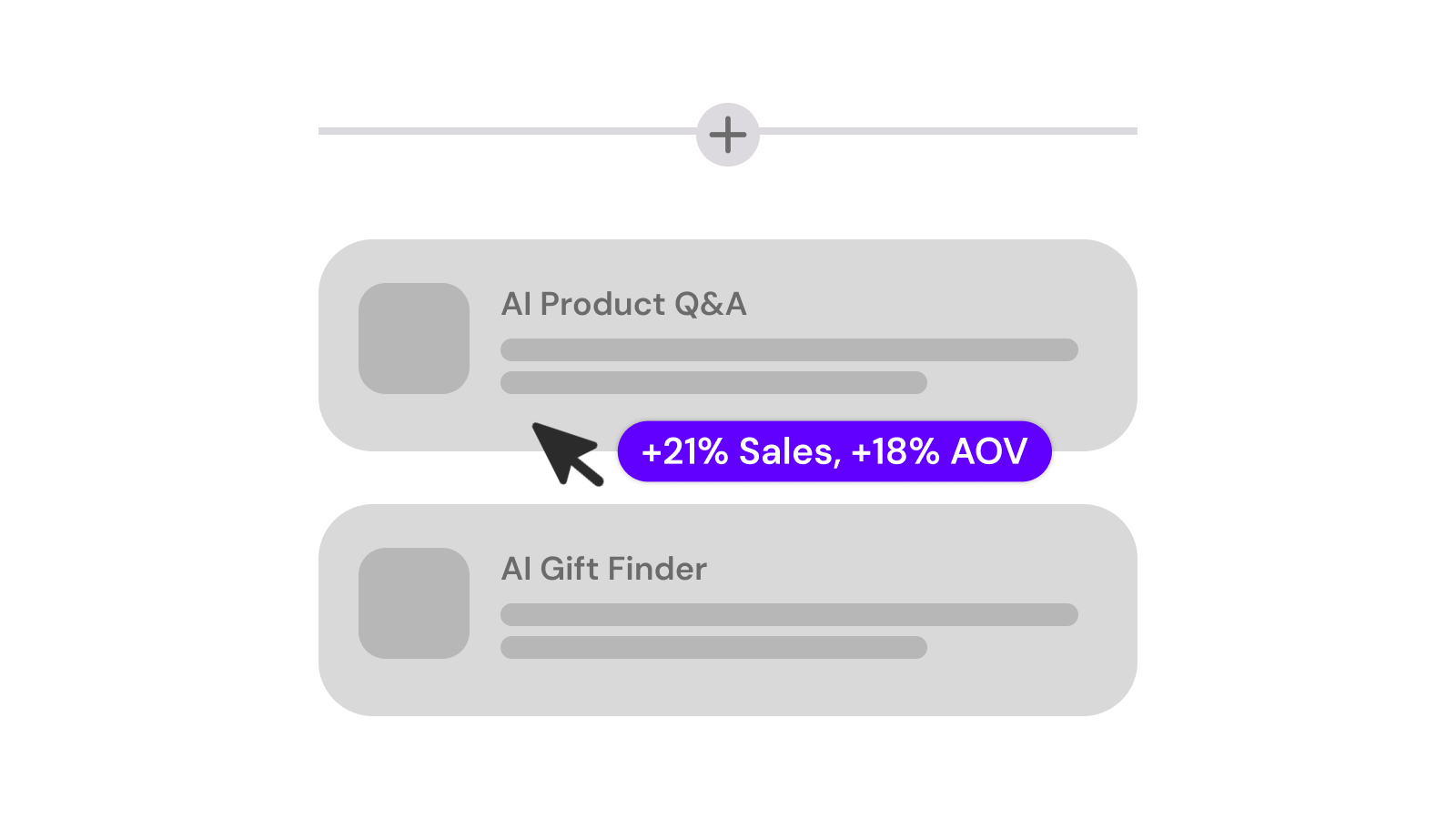
The day was also a media day. Alexis pitched Humind on the booth's stage, recorded a podcast with a Microsoft France executive, and we gave several interviews to journalists covering the show. J'aime les startups turned it into an article that quotes our results: a 21% increase in sales and a 19% increase in average order value.
All of this stems from the Microsoft GenAI Studio program at STATION F. In the article Microsoft published on May 20, 2026, after the cohort's Demo Day, it is stated that visitors who interact with our agent convert up to 21% more than others, and that the average size of our new clients tripled in four months. Earlier, in an article published by SKEMA on January 14, 2026, Humind was described as working with around a hundred clients, including Puressentiel, Izipizi, La Chaise Longue and Supersmart.
Four things to remember, even if you were not there
- The market has moved past the question "does AI work in e-commerce". The question is now about governance: sourcing, refusal, escalation, traceability, proof of quality.
- Enterprise brands are arriving on the topic, with their own requirements: security, SSO, data hosting, and longer cycles that have to be prepared early.
- Conversational data is becoming a merchandising and product input, not just a support metric.
- Large accounts evaluate the operating model around the agent as much as the agent itself.
If these questions sound like yours, the fastest path to an answer is the same as in Hall 7: see it run on a real catalog. You can discover our approach to agentic commerce, browse concrete e-commerce use cases, or simply book a live demo and take the keyboard, exactly like our visitors.