





From March 10 to 12, 2026, Humind spent three days in Monaco at One to One Retail E-Commerce, as part of the Startup Village. It was our first trade show, and the biggest of the year for French retail. The format is like no other: an agenda built almost entirely on one-to-one meetings booked in advance, a two-minute pitch to explain what an AI sales agent really does, and more than ninety demos in three days. Here is what retail decision-makers were asking, and what we brought home.
A trade show built on meetings
One to One Retail E-Commerce, organized by Comexposium at the Grimaldi Forum, held its fifteenth edition from March 10 to 12, 2026. The principle has not changed since year one: the event is built on short meetings scheduled in advance between retail decision-makers and vendors, rather than on visitors who might happen to walk past a booth. Each side declares what it is looking for, a matchmaking system creates the pairs, and you arrive with a full agenda.
Rather than waiting to be noticed, you spend three days in back-to-back meetings with e-commerce directors, digital directors, CRM and data leads, most of whom have a project underway and a budget line. Around 200 vendors and more than a thousand decision-makers were on site.
The theme chosen for the fifteenth edition said a lot about the state of the market: Mutations, the new codes of a three-voice commerce. The idea: the brand and the customer are no longer alone in the conversation. An AI layer now sits between them, in search, in recommendation, and increasingly at the moment of purchase. That layer is exactly what we build.
How you get into the Startup Village
The Startup Village hosts twenty selected companies, set up in the main entrance of the Grimaldi Forum. Our booth was at the very entrance of the village, on the main aisle: everyone walked through to reach the other booths, and many visitors stopped spontaneously to discover the new startups. On top of our scheduled meetings, we had a continuous flow for three days.
The selection stretched over several months: we applied in the fall of 2025, were shortlisted among thirty startups by the event's jury in December, pitched remotely on January 16, 2026, and learned the same day that we were in. The organizers look for a precise maturity: neither a pre-product idea, nor an established vendor, but a solution already in production and still under the radar of most retailers.
The village had another effect we had not anticipated: the nineteen other startups. Most are not competitors but solutions complementary to ours, on neighboring links of the e-commerce journey. Three days side by side means a lot of insights exchanged, favors traded, and contacts that still last.
What retailers were asking an AI sales agent in March 2026
We had done enough meetings in 2025 to have a point of comparison. The questions had changed.
From does it work to who owns the conversation
Almost nobody asked whether a conversational agent could understand a shopper. That debate is closed. What came back, meeting after meeting, was the question of control. If an AI layer answers the customer, who writes what it says? Who is responsible when it recommends the wrong product or promises a delivery date? Can the merchandising team fix it without opening a ticket with the vendor? Teams that had run a POC in 2025 arrived with the list of what had gone wrong, and wanted to know how we handled each case.
Data and governance before features
Second recurring theme, and a more decisive one: where the data goes. Hosting region, model providers, retention, what leaves the store, what an agent is allowed to read in an order management system. Several conversations went straight from what does your product do to send me your security documentation. A year earlier, that question came at the end of a pilot. In Monaco, it came in the first five minutes.
Staying readable for machines without losing your brand voice
The most interesting tension in the room was the one the program itself named: how to stay readable for algorithms without becoming interchangeable for humans. Retailers see their product data consumed by assistants they do not control, and are looking for what remains of a brand when recommendation happens elsewhere. Our answer: the agent installed on your own store remains one of the few places where you still set the tone, the ranking and the guardrails, the argument we develop on our agentic commerce page.
Ninety demos, and two insights that changed our roadmap
More than ninety demos in three days, and our first clients met in person: Monaco was the moment the product faced the market at scale. Two lessons came out of it, and both directly changed what we build.
Verticals we had not imagined. Humind verticalizes by sector: an agent for beauty does not ask the same questions as an agent for health and wellness or for the home. Beauty, personal care, food supplements and parapharmacy were heavily represented in Monaco, with their own brief: regulated claims, advice that must stay cautious, high returns when the shopper picks the wrong shade or formula. But the meetings also surfaced sectors we had not thought of: travel, intimate wellness, furniture. Each came with precise needs, and several dedicated features built since then come from those conversations.
Retailers want one solution that does everything. The second signal, heard meeting after meeting: nobody wants to stack a sales tool, a support tool and an analytics tool on the same store. So we built support features on top of sales for many clients: a single agent on the site that advises and sells, but also handles common requests and hands over to the team when needed. For several clients, it has noticeably lightened the support load.
What worked in our pitches and demos
The village startups pitched for two minutes on stage, on March 11. Two minutes is not a short presentation, it is a different exercise. Three things worked particularly well.
The live demo, not the screen recording
We showed the product live, on a real store, instead of playing a video. It is riskier, and that is exactly why it works: because the agent is agentic, we could feed it very complex requests live, the ones the audience chose, and watch it reason and answer. That is the effect that impressed people, and no screen capture produces it.
Numbers, with their scope
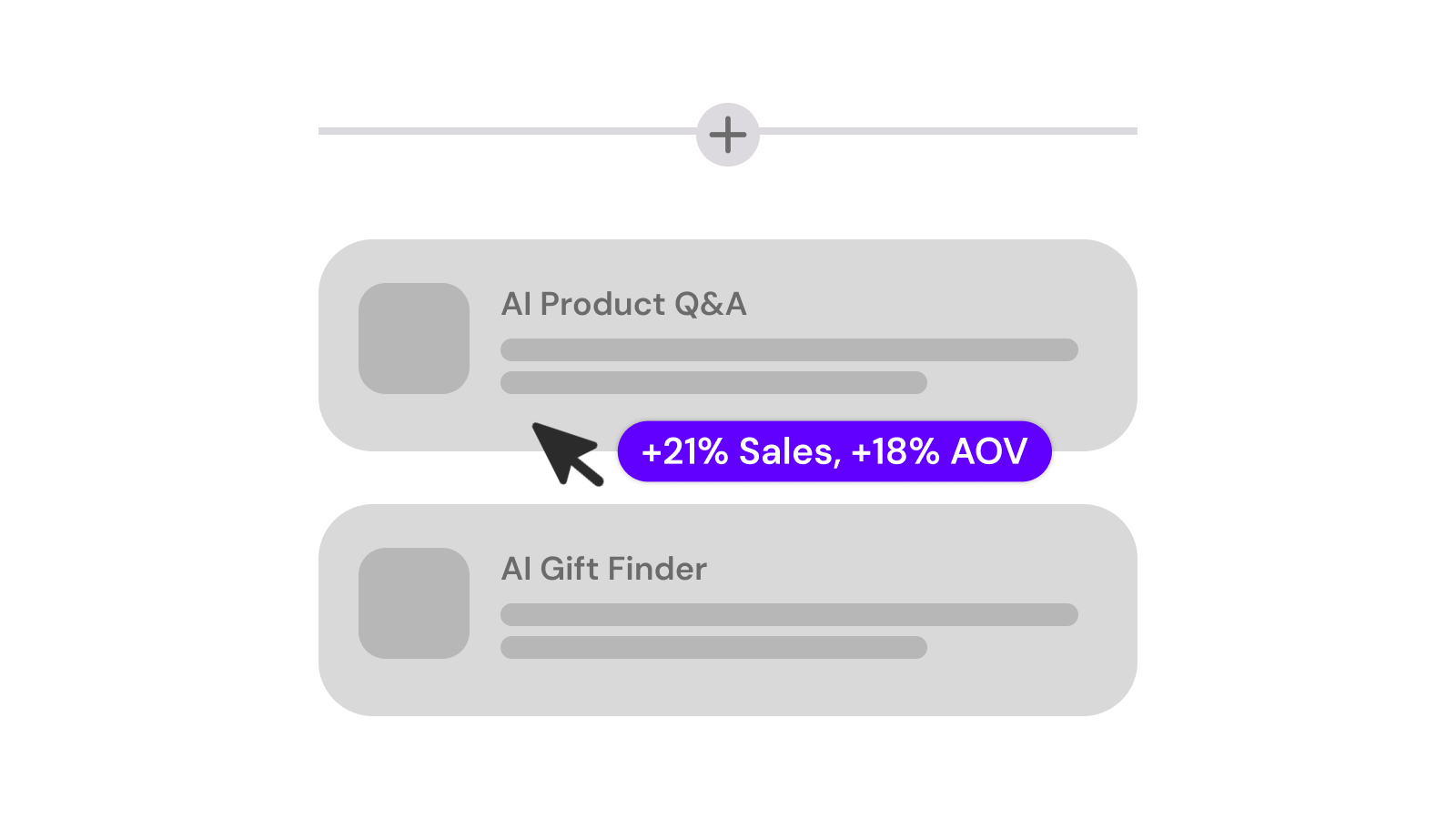
We gave our numbers with what they measure: on average, around a 13% increase in sales across all sectors, and up to 21% more conversions with some clients, as SKEMA Business School reported in January 2026, with a 19% increase in average order value on the same test. Another number that surprised people: 4 to 5% of a site's visitors use the solution, a high engagement rate for this type of tool. And the agent is useful even to those who never write to it: our in-page AI modules, gift finder, product FAQs, collection quizzes, work directly in the journey, without a conversation.
Saying what it plugs into
The most frequent question after the pitch was not about the model, but about compatibility with the existing stack. Being a Shopify Partner immediately reassures brands, and being precise about the rest of our e-commerce integrations saved more meetings than any product promise. Many of the brands we met run on custom catalogs or other platforms, Magento or WooCommerce for example: following the show, we expanded our documentation and built custom APIs to connect to any store.
If you are aiming for the Startup Village
Three practical notes for founders looking at the startup space of One to One Retail E-Commerce: apply early, the funnel runs from fall to January and the selection pitch closely resembles the one you will do on stage. Fill in your matchmaking profile with the sector and deal size you actually want, the meetings you get are the ones you asked for. And prepare the follow-up before you leave: the value of the event plays out in the two weeks that follow.
What we brought home
Around thirty clients signed came directly from this show. But the most lasting contribution is elsewhere: three days meeting industry professionals in person, including our own clients for the first time, gave us a volume of feedback no remote channel provides. The market has stopped asking whether AI belongs in the purchase journey, and has started asking who controls it, what it is allowed to see, and how a brand keeps its voice when a machine speaks for it. These are harder questions than a year ago, and better ones. They confirmed the product's direction, and they opened new ones.
If you are asking the same questions for your store, the fastest way to see how we answer them is to book a demo of the Humind AI sales agent.